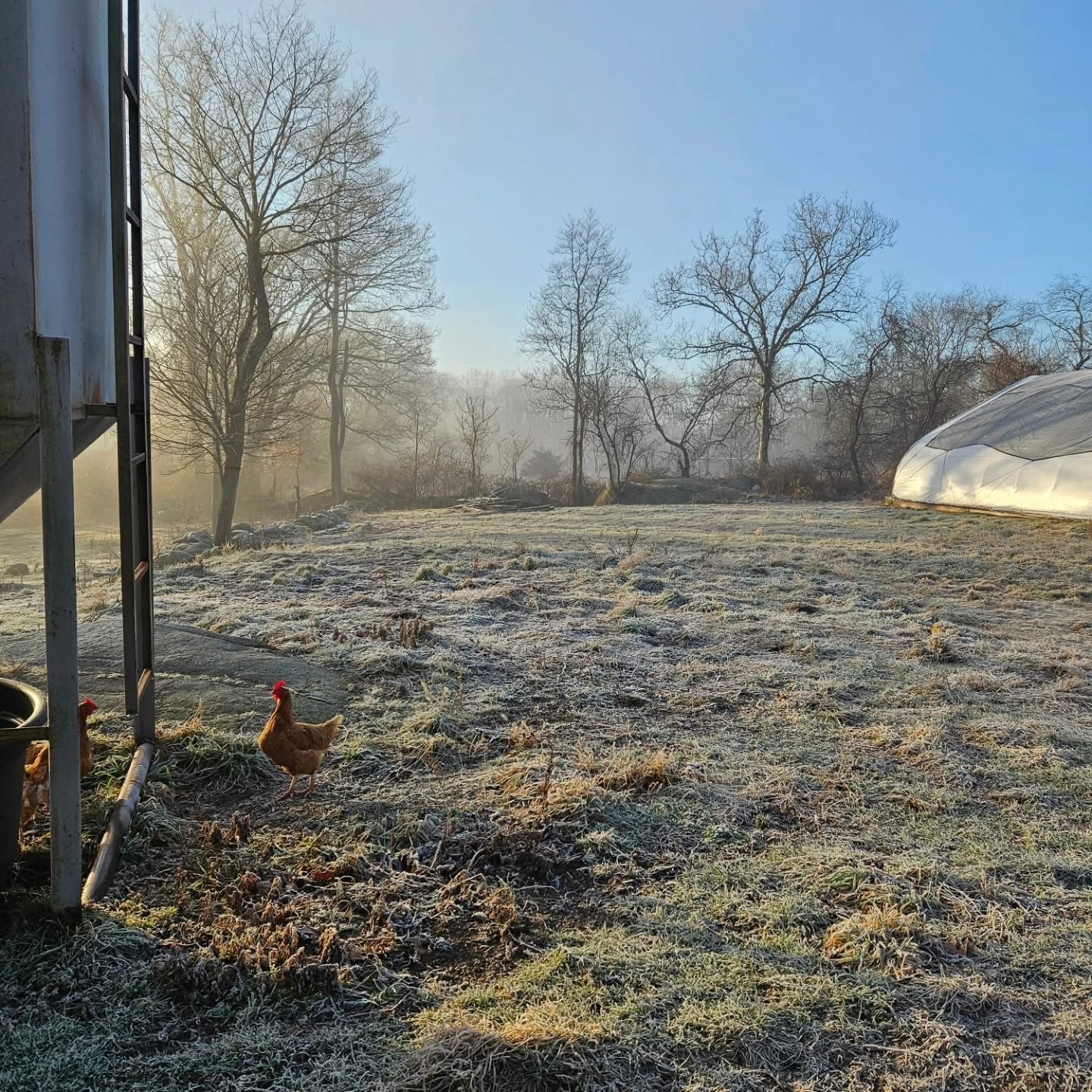
The farmhouse at 241 Cornell has stood since 1900. For generations this ground has produced food — from acres of fruit in the orchard to tomatoes under cover, in the greenhouse that still anchors the back of the property. Then the farm went quiet. The fields sat. And Rhode Island did what Rhode Island does to untended pasture: it sent in the vines.
By 2014, thorned runners had swallowed what was once open ground. Most buyers saw a problem. One family saw a farm waiting underneath.
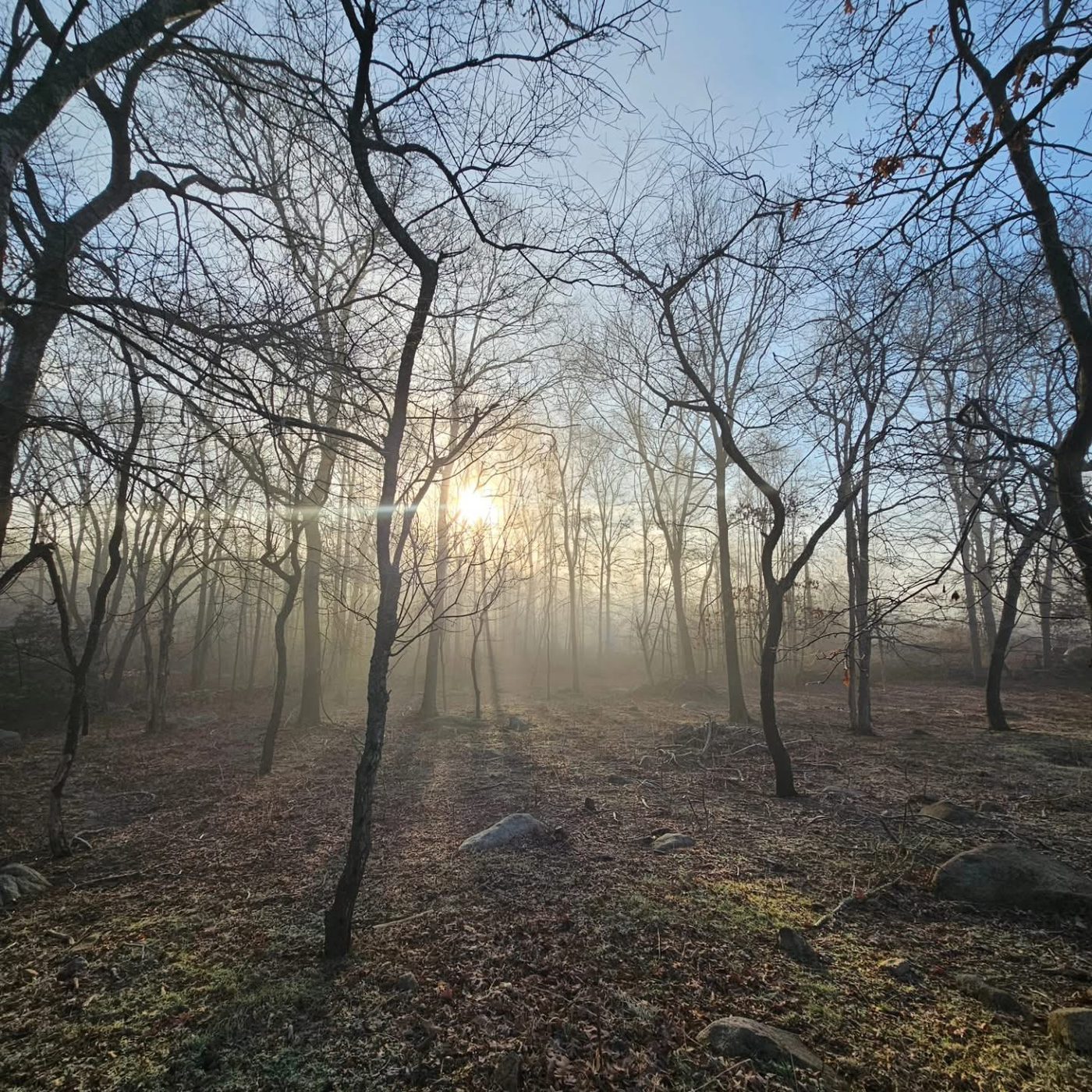
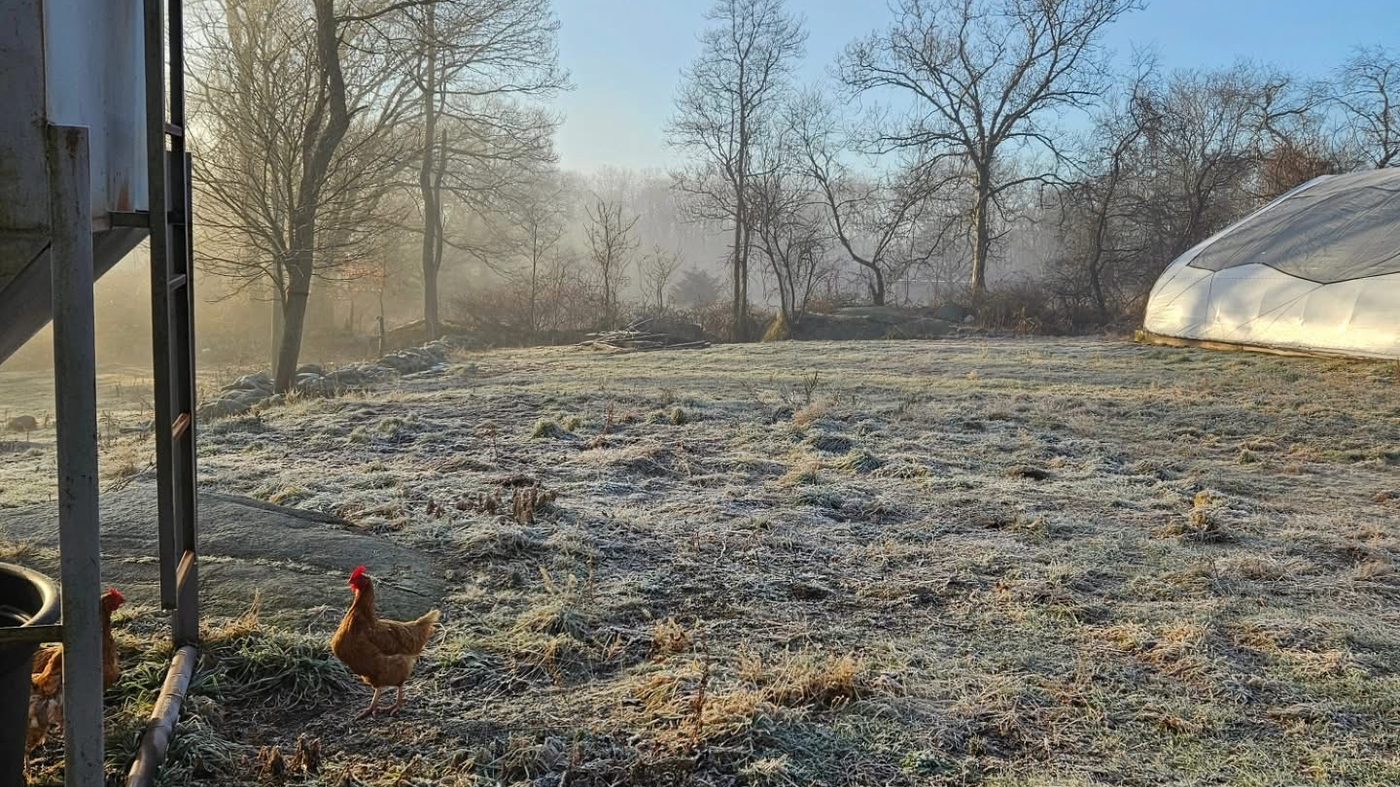
Sunrise over the back acres.
“It started with a mother's question: what's in my child's food?”
Chapter 02
From São Paulo, by way of Boston
Ester Bishop grew up visiting her grandfather's farm outside São Paulo, Brazil. Decades later, living in Boston with a newborn, she wanted one simple thing: to know exactly what was in the food she fed her child. That question wouldn't let go.
So she and Joel sold the house in Boston, fell for a small coastal town called Tiverton, and bought sixteen overgrown acres with a 114-year-old farmhouse on it. The vines had taken the place over; clearing them was the first season's work.
“The vines took the land. The animals took it back.”
Chapter 03
The animals cleared the land
They tried the tractor. The vines came back by spring. So they learned what farmers here knew a century ago: put the animals to work. Goats first, then pigs — rooting, browsing, fertilizing — reclaiming pasture the regenerative way, no chemicals, season by season. The land didn't just get cleared. It got better.
That's still how this farm runs. The animals feed the soil, the soil feeds the animals, and nothing useful leaves the loop.
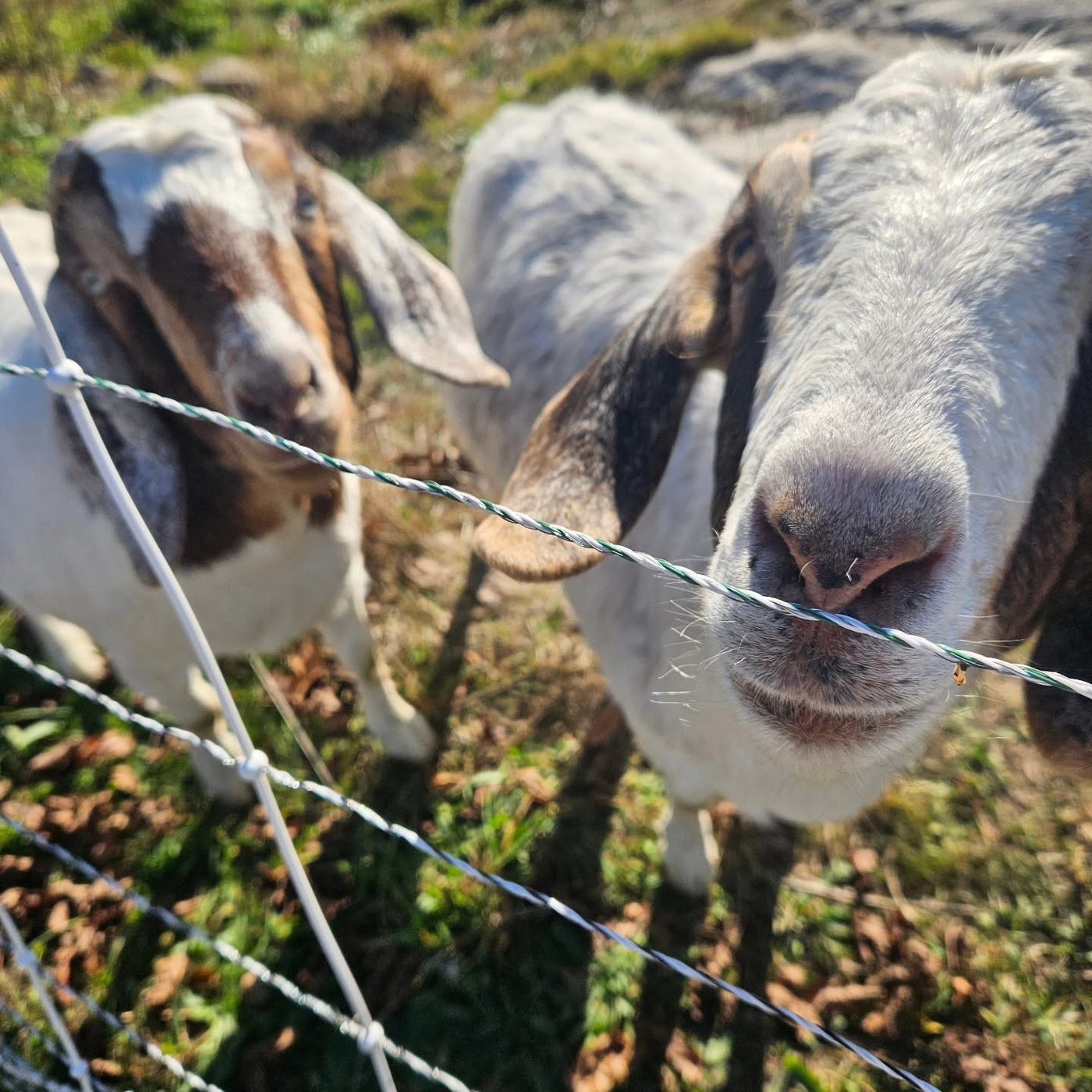
The animals that took the land back.
“From 12 dozen eggs a week to 300.”
Chapter 04
Twenty-five hens started a business
It began as a homestead: twenty-five laying hens, eggs for the family. Then a farm-to-table restaurant asked to buy the extras. Then the chefs started calling. Demand ran from twelve dozen eggs a week to three hundred dozen, and the Bishops made the leap from homesteaders to farmers — pastured meat birds, pigs, a name at the farmers markets, accounts with kitchens across the South Coast.
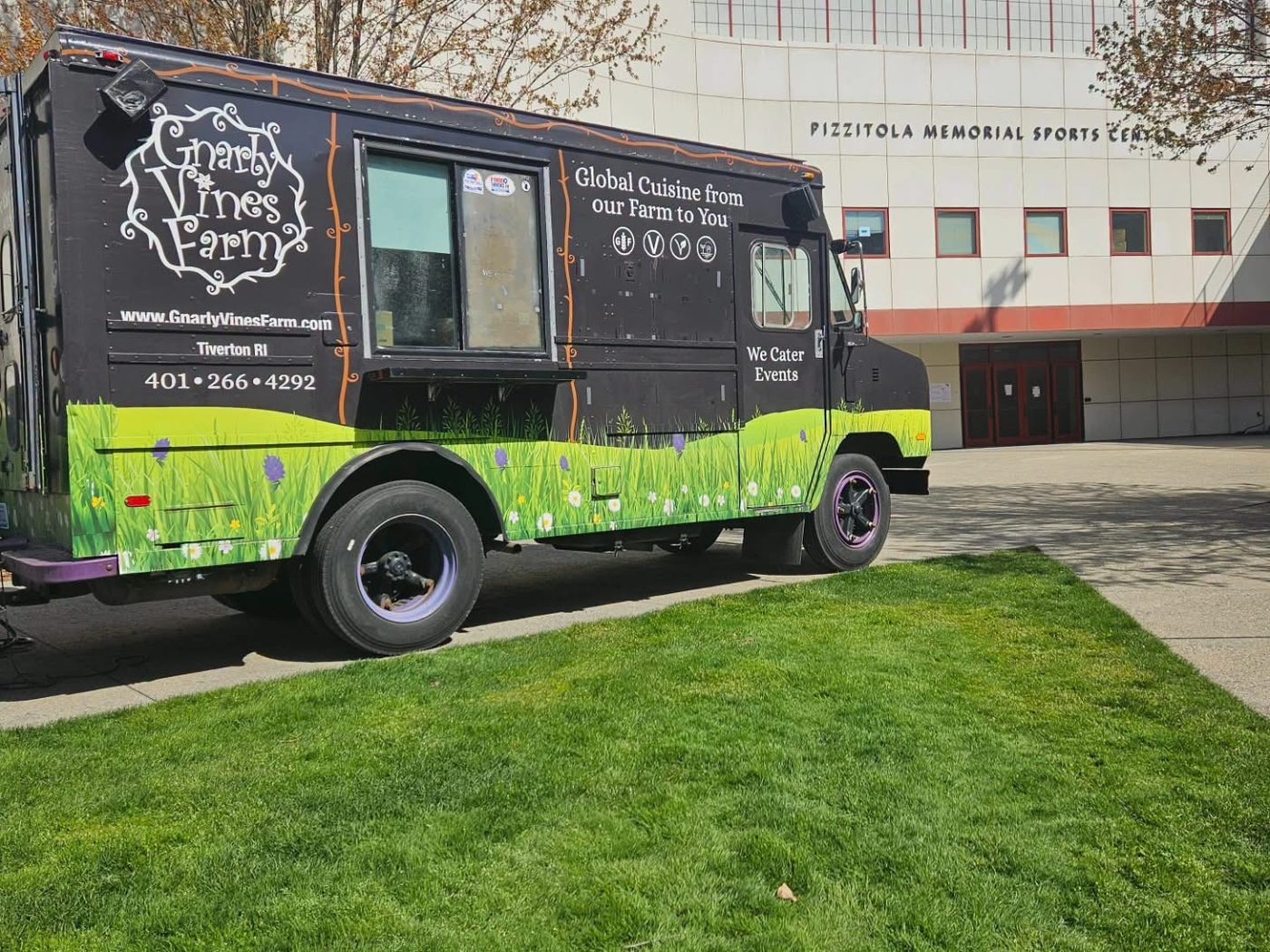
The farm food truck — on the road across the South Coast.
What makes 241 Cornell rare isn't any single piece. It's that the pieces connect:
The wells — a residential well serving the farmhouse and a separate agricultural well — feed the home and irrigation across the property.
The sun powers it — a 32-panel solar array (2021) offsets the farm's energy.
The pasture. Current livestock is small: a donkey, two goats and a goose. Poultry is raised seasonally, March to November.
The processing unit — Rhode Island fowl licensure is in progress; USDA inspection would be a later step — turns harvest into product on site.
The food truck takes it on the road across the South Coast.
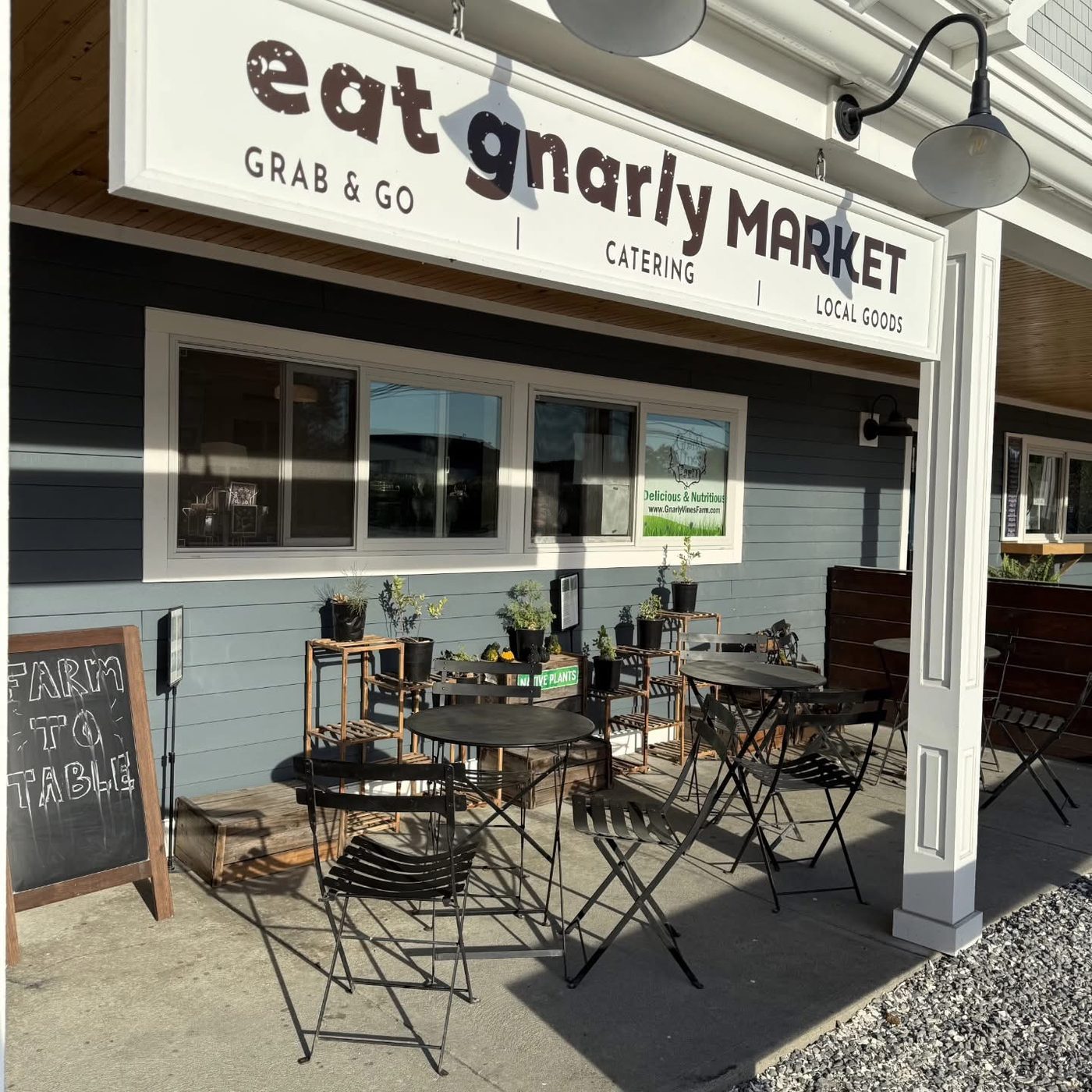
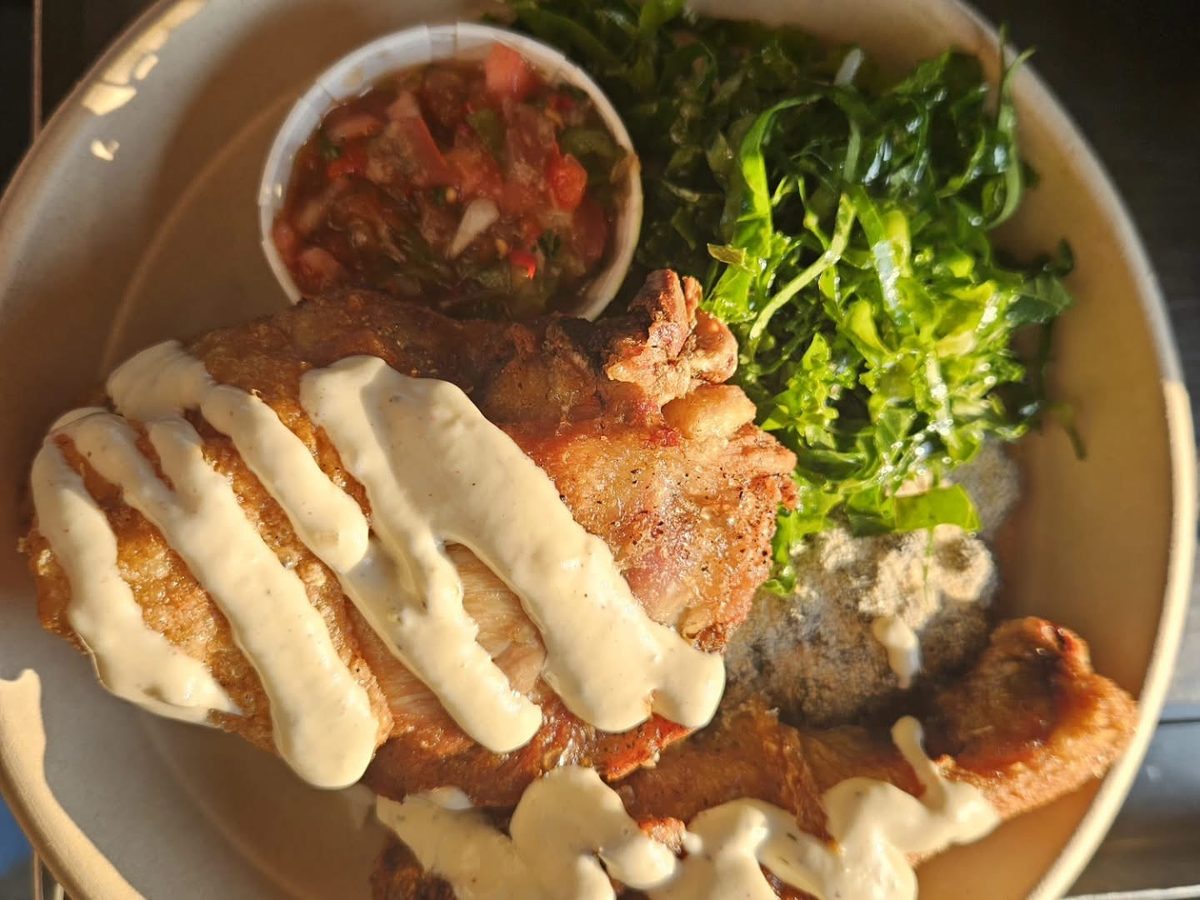
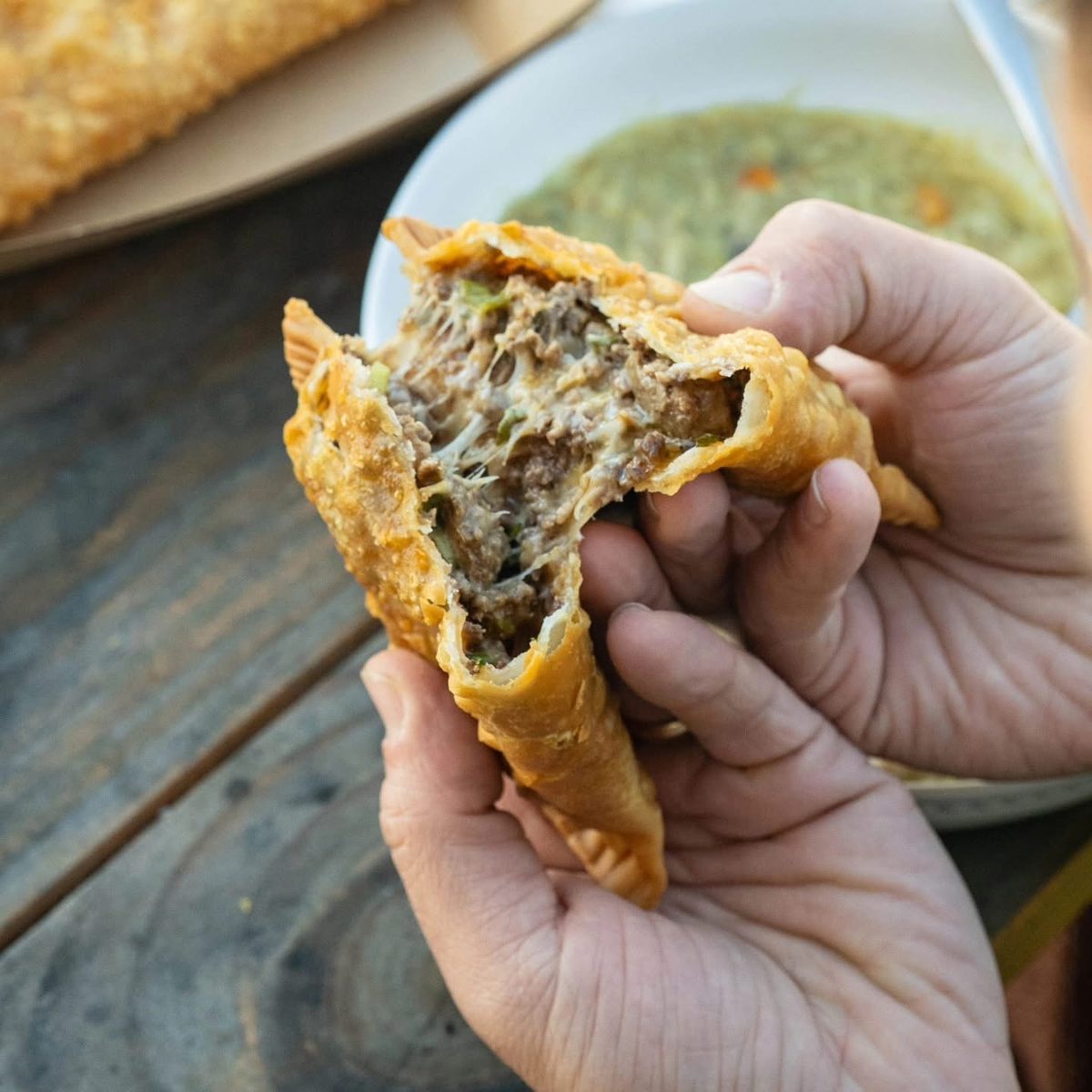
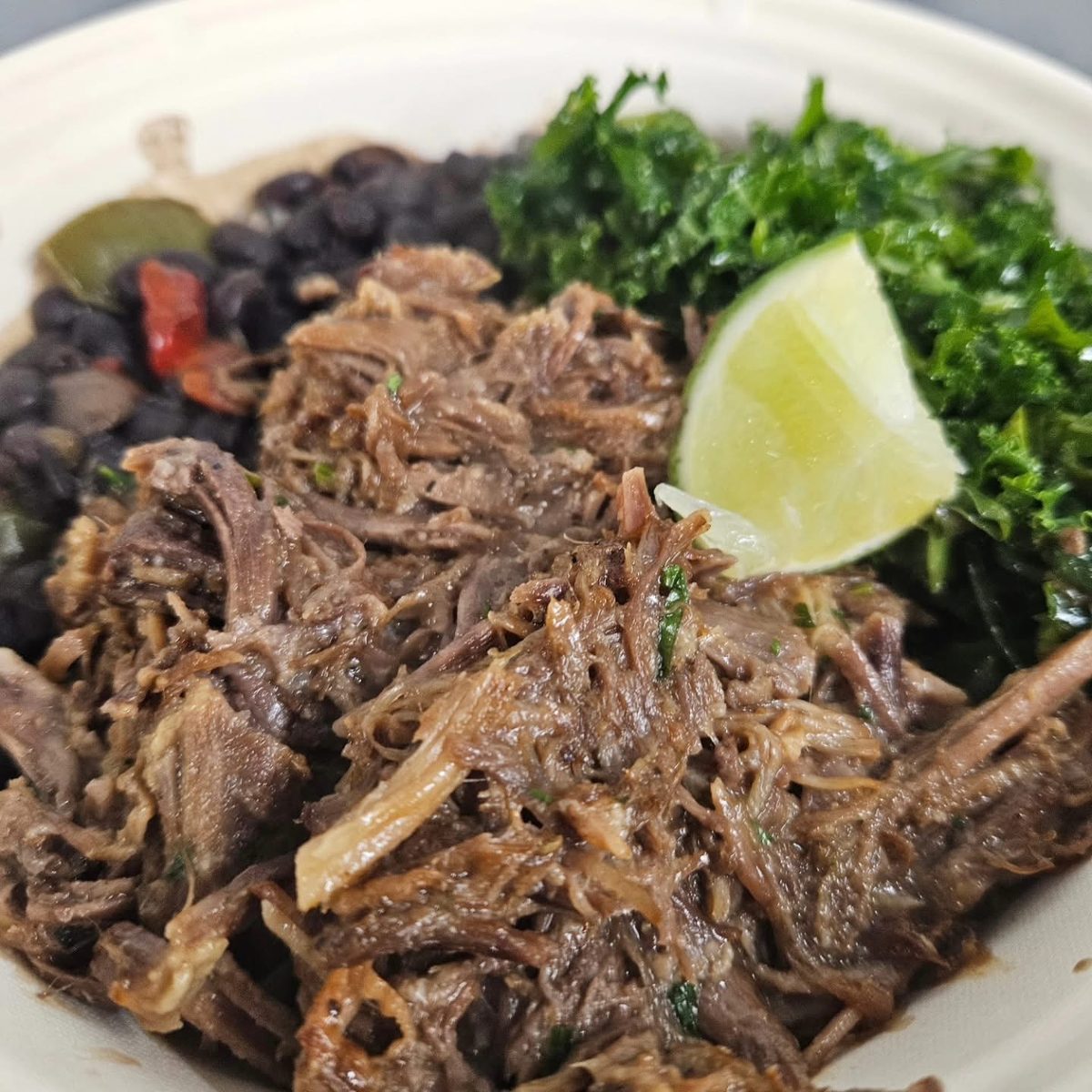
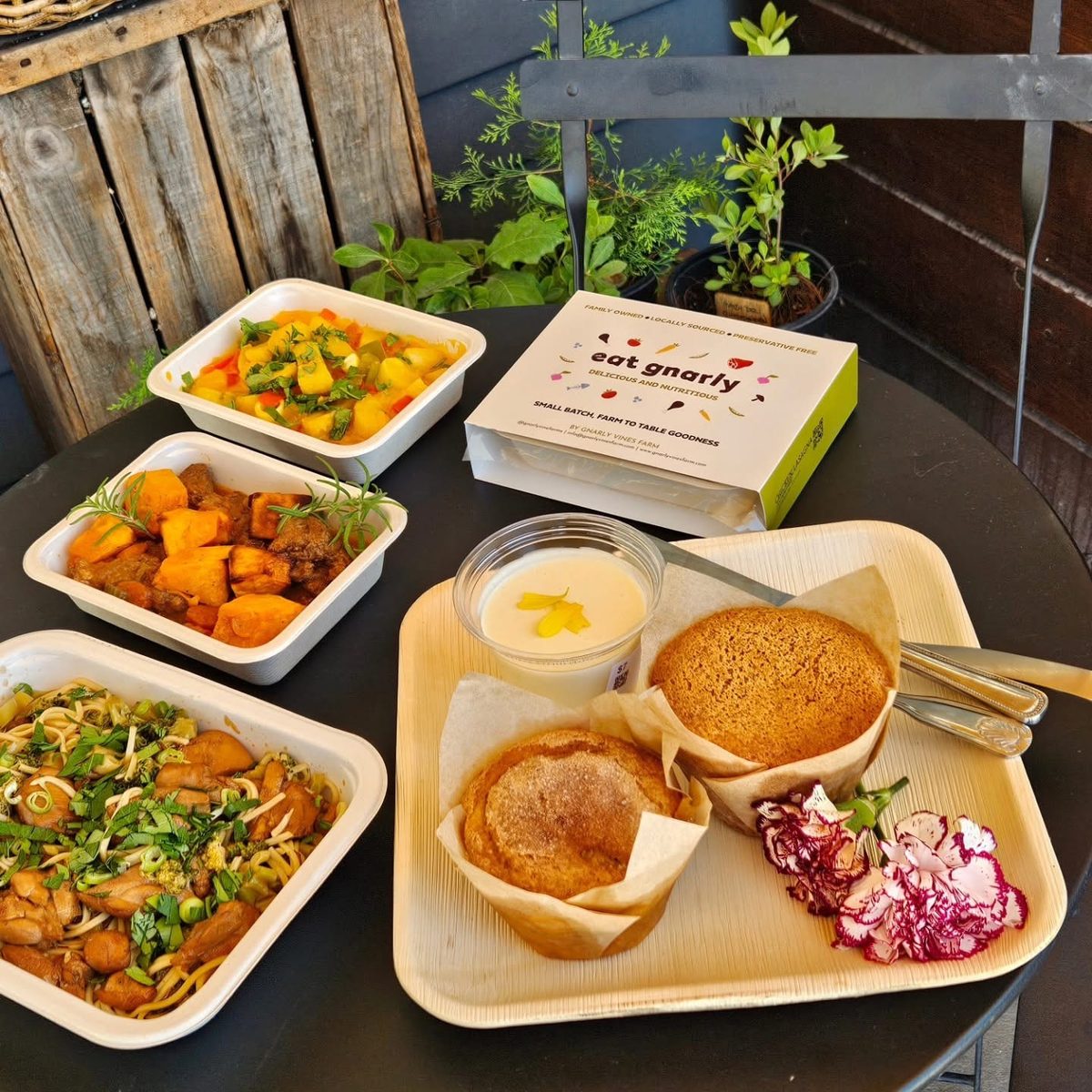
The farm market on Main Road puts it on plates: the farm's own pasture-raised chicken, prepared meals, and the signature Farmhouse Fried Chicken. The kitchen's range is proven — under the current owners it has run from comfort plates to Ester's Brazilian table: empanadas; feijoada of woods-raised pork stewed in black beans; kale salad and jasmine rice; vegan versions alongside — the spread that made the press. The recipes, methods, and know-how convey — and the owners stay on to teach them, hands-on, through the transition — so the next operator can run it from day one and take the kitchen any direction they choose. The owners provide hands-on training before closing, introductions to every customer and vendor, and twelve months of unpaid advisory support after.
Raise it, process it, sell it, serve it. Most farms sell a commodity. This one sells the finished plate.
The farm market, on Main Road.
“Raise it. Process it. Sell it. Serve it.”
Chapter 06
The business travels with the deed
241 Cornell Farm has been written up in the regional press, holds standing accounts with South Coast chefs, and carries an audience that built itself one farmers market at a time. The buyer isn't starting a farm. They're stepping into one mid-stride — customers, recipes, accounts, and reputation included.
“Not a farm for sale. A food system changing hands.”
A century-old farm, brought back by hand, built into a food system, ready for its next steward.
Link copied
Figures, brand, press, accounts, customer-base, and processing/certification status described in this section are owner-represented and confirmed during due diligence; processing is in progress and permitted uses are subject to USDA and Rhode Island regulatory approval.
For the ones who think about leaving
You’ve had this thought before.
Link copied
On a commute. In a kitchen that doesn’t grow anything. The thought goes: somewhere there’s a piece of land, and a version of your life that makes things instead of just buying them. Then the thought hits its three walls — I wouldn’t know how. I could never afford it. I’d be starting from nothing, alone.
Here’s what’s different about this farm: someone already ran your experiment. In 2014, Joel and Ester Bishop left the city with a newborn and no farming résumé. They learned it — the press watched them learn it — and built a brand, a store, a truck, and a customer base that now convey to whoever comes next. You wouldn’t be starting from nothing. You’d be starting from everything they built.
And the affording part has a real answer: financing paths exist for a buyer like you — including programs that let qualified beginning farmers step in with as little as 5% down.
The dream doesn’t need you to be fearless. It needs you to ask for the package.
Financing descriptions are informational, not a commitment to lend; all loans subject to lender underwriting, program eligibility, and buyer qualification. Program terms and limits change — verify with lender and agency. Revenue figures per owner's 2025 books, pending verification.
Not ready to raise your hand? Leave an email — you'll be first to hear when pricing and showings open.
The whole greater than its parts
One integrated food system
Land and inputs on one side, brand and channels on the other — every piece feeding a single hub.
Revenue figures are per owner's 2025 books; lease terms are owner-summarized — the actual figures and lease documents are in the package and confirmed in due diligence.
Where it all sits
Growing / livestock
Water / power
Homes
Feed / access
Schematic, not to scale.
The water
Water built for production
Most farms make do with a well. This one has an engineered public water system: a dedicated well, a water storage tank, and distribution piping, built for the food and poultry operation and reviewed by the Rhode Island Department of Health. The engineering is stamped by a licensed professional engineer, the well pump test is complete, and the state has issued preliminary approval, with final approval pending routine start-up sampling. A regulated system like this is costly and slow to build from scratch. For a buyer continuing the public-facing food business, it is a major head start that is already substantially in place.
Public water system status per Rhode Island Department of Health preliminary approval; final approval subject to standard conditions and sampling; verify in due diligence.
The operator’s week
A week that runs the whole business.
Hands-on processing is three days; the truck, storefront, and crew carry the rest. A staffed business with a rhythm, not a seven-day grind.
Mon
Prep / off
Tue
Processing
Wed
ProcessingEat Gnarly Market
Thu
ProcessingEat Gnarly Market
Fri
Food TruckEat Gnarly Market
Sat
Food TruckEat Gnarly Market
Sun
Food Truck
ProcessingFood TruckEat Gnarly Market
Illustrative weekly rhythm; actual schedule varies by season and demand.
The protein engine
A processing unit on the property
Mobile processing unit conveys. Rhode Island fowl licensure in progress; USDA inspection not yet started. A buyer would hold the license in their own name.
Once licensed, birds can be processed right here, on the owner’s own schedule — no hauling out, no waiting on a third-party plant’s calendar. It can be put to work two ways:
The farm’s own birds — raised, processed, and sold inside the operation, with every step kept under one roof.
Custom processing for other farms — capacity put to work for neighboring growers who have no plant of their own, subject to licensure.
Licensure status is owner-represented; verify license status and conditions in due diligence.
From the kitchen
What it puts on the table
Farmhouse fried chickenEmpanadas from Ester’s kitchenPasture-raised, on a plateCatering & prepared meals
What conveys
What you’re buying
The real estate — 15.98 acres, the 1900 farmhouse, and farm structures
Two greenhouses — the 30×100 housing the chickens, the 60×200 an uncovered frame — and feed stations
Mobile processing unit conveys. Rhode Island fowl licensure in progress; USDA inspection not yet started. A buyer would hold the license in their own name.
32-panel solar array (2021), equipment, and feed / animal infrastructure
An engineered public water system (well, storage tank, and distribution) with RIDOH preliminary approval, in addition to the two wells
The operating business — recipes, customer reputation, and the product lines (the food truck, the farm market, and Farmhouse Fried Chicken), as the buyer chooses to carry them forward
The farm's USDA Value-Added Producer Grant: approximately $85,000 to $90,000 remaining as of September 2026, declining monthly. USDA has confirmed the grant is transferable in principle under 7 CFR 4284.962, subject to case-by-case approval and stated conditions.
Wholesale chef accounts and the customer base
Livestock at count on closing day, and inventory as itemized in the package
The farmhouse
3 bd · 2 ba1,632 finished sq ft
1,088 sq ftfirst floor
544 sq ftfinished half story
Built 1900oil heat
Per Tiverton assessor property card (511-133). A precise inventory of what conveys — real estate, business assets, recipes/IP, equipment, livestock at count on closing day, and the farm-market lease — is detailed in the full package and confirmed during due diligence.
Why a farm pays differently
A farm is a different kind of taxpayer
Link copied
This land is enrolled in Rhode Island's farm-use assessment program — the town taxes it as working farmland rather than at development value, which keeps the annual property tax meaningfully lower: about $5,800/year at the current farm-use assessment (vs. about $8,200 without it). Confirm with a municipal lien certificate. The classification can transfer to a buyer who keeps the land in agricultural use.
Owning a working farm changes your tax picture in ways ordinary property never does. The headlines:
Lower property tax — sixteen acres, the farmhouse, and every structure carry a total bill of about $5,800/year at the current farm-use assessment (vs. about $8,200 without it) — in the neighborhood of what an ordinary Rhode Island house pays on a fraction of the land. That's the farm-use assessment working. Confirm with a municipal lien certificate.
The operation deducts — feed, fuel, seed, repairs, vet bills, insurance, utilities: legitimate farm expenses run against farm income on a federal Schedule F.
Things wear out, on paper — equipment, fencing, wells, greenhouses, and farm structures depreciate; current law lets much equipment be expensed quickly.
Sales-tax relief — Rhode Island farmers can qualify for exemption certificates on qualifying farm supplies and equipment.
Income smoothing — federal farm income averaging can spread a good year across several, softening the tax hit.
The long game — conservation and farmland-preservation programs (state and federal) can pay for or deduct the value of development rights, for owners who choose that path.
Educational overview only — not tax, legal, or financial advice. Eligibility and benefit depend on how the farm is owned and operated; rules change. Buyers should consult a CPA experienced with agricultural taxation. Benefit descriptions are general and not specific to any buyer. Farm-use assessment is set by the Town of Tiverton; continuation subject to program requirements. A change of use can trigger a state land-use change tax — details in the buyer package.
Tax-efficient ownership
A working farm changes a wealthy household's tax picture.
Link copied
Smart money doesn't buy a farm to lose money for the deduction — that's bad math, and they know it. They buy a farm because it does four things at once that almost no other asset does. The tax treatment is the seasoning, not the meal.
It lowers the tax on land you'd want anyway — beautiful acreage taxed as an estate is punishing; taxed as a working farm, it's a fraction. This property is already enrolled.
A real operation earns real deductions — legitimate expenses and depreciation flow through a genuine business. Run actively, they can reach beyond the farm.
The conservation lever — significant acreage can yield a cash payment or a charitable deduction by preserving development rights, while you keep and work the land.
It's a wealth and estate asset — a hard, appreciating holding that can pass to heirs at farm-use value, not development value.
The test of all of it is whether the position survives a professional's eye. Hand this offering to a buyer's accountant and here's what they notice:
The participation is staffable — a resident caretaker and existing team make active, documented ownership realistic for someone with another career.
The depreciation menu is full — equipment, vehicles, livestock, and agricultural structures give the purchase price somewhere productive to go; land alone offers nothing.
The property-tax benefit starts day one — farm-use assessment is already enrolled and transfers with continued agricultural use; nothing to apply for.
There are moves left for later years — development-rights programs and farm estate-valuation rules keep planning options on the board.
Most farm listings make an accountant nervous. This one was built to make their job easy — the full brief, in the buyer package, is written for exactly that reader.
Educational overview only — not tax, legal, or investment advice. Federal hobby-loss, material-participation, and passive-activity rules strictly limit benefits where a farm is not operated for profit or the owner is not sufficiently involved; eligibility is fact-specific. Consult a CPA and attorney experienced in agricultural taxation before purchase. The full brief is in the buyer package, available under NDA.
The caretaker
The farm doesn’t stop when you sleep
A working farm needs working hands, and 241 Cornell comes with them. A resident farm hand lives on the property in separate, self-contained caretaker quarters set apart from the main farmhouse, under a labor-for-housing arrangement.
What that means for the next owner:
Continuity. The person who knows the animals, the water lines, and the morning routine is already here.
Privacy. Separate quarters mean the owner's home stays the owner's home.
Built-in management. Travel, keep an off-farm career, or scale up — the daily work doesn't depend on you being in the barn at dawn.
Few properties at this size offer turnkey labor with turnkey land. This one does.
Described as a property and contract feature: the caretaker quarters and an existing labor-for-housing arrangement, conveyed subject to its terms and applicable law. Any continuation of the occupant's residence is at the buyer's option and is not guaranteed, subject to the occupant's rights under applicable housing and labor law. Details are provided in the package.
The 60×200
A quarter-acre under one roofline, waiting for its assignment.
Link copied
2014 — in full productionToday — ready for its next grower
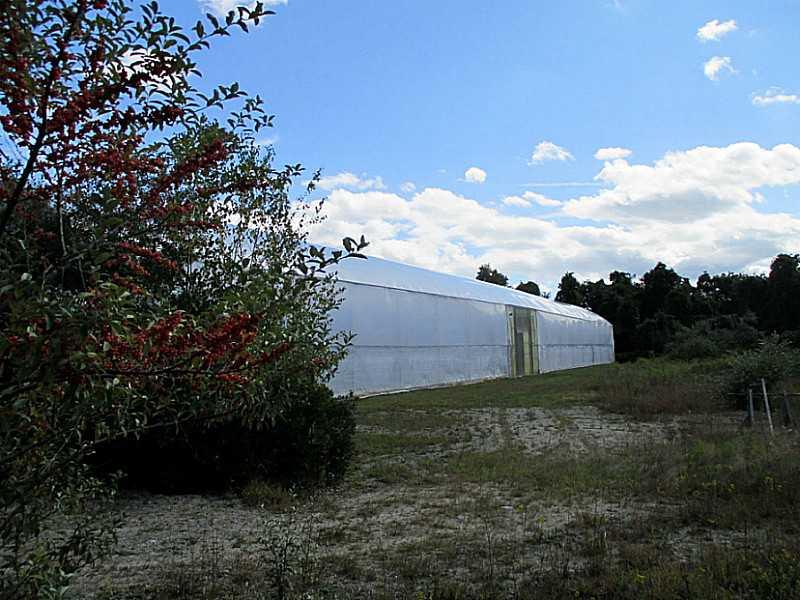
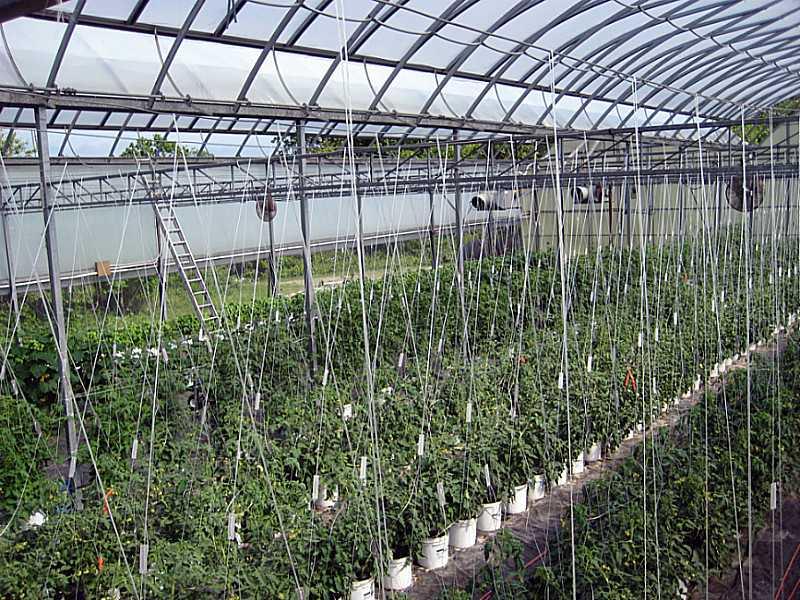
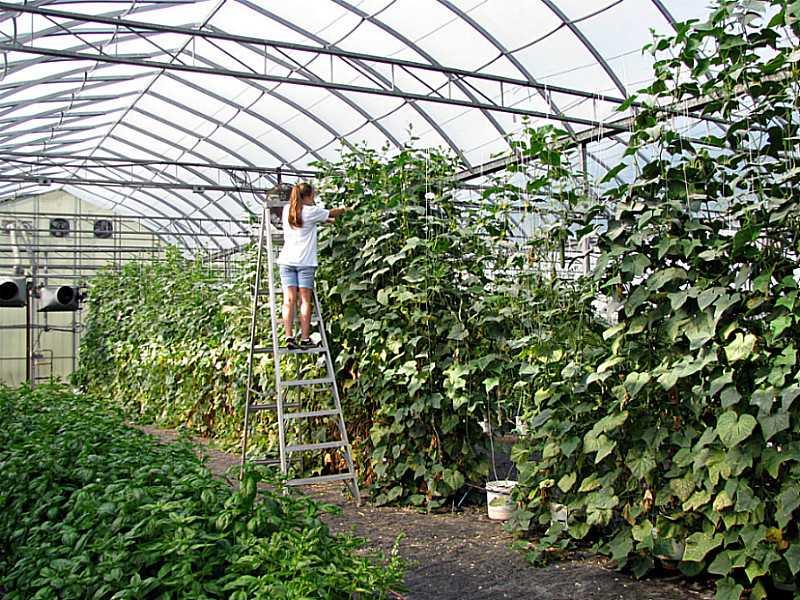
Let's name it plainly: the biggest structure on this property is a bare frame. The plastic is gone; inside is open ground. It's also the property's largest single opportunity, and the photos above show why — this house ran high-wire tomatoes at commercial scale, and the steel that did it is still standing.
High-wire tomatoes on the lines — this house, 2014.Working the vines — the ceiling is the point.
What a buyer does with it is a choice, not a problem. Five doors, all real:
Re-cover for vine crops — restore the original engine: tomatoes and cucumbers, sold through channels this farm already owns.
Re-cover for poultry — up to 4,000 birds in the house, roughly 2,000 harvested a month in season, subject to processing licensure.
Lease it — covered growing space is scarce in this state; re-cover and rent bays to a grower for income without operating.
Run it cool — a three-season house for greens and season extension, no heating bill, while the low house carries winter.
Use it bare — equipment, hay, and livestock shelter from day one, at a cost of nothing.
Now the part worth slowing down for. Erecting a commercial frame of this scale new — engineered steel, this height, this span — runs well into six figures before any covering goes on. The Town of Tiverton's assessment carries both of this property's greenhouse structures at $24,800 combined. A buyer here pays for steel priced as a line item and receives infrastructure priced, anywhere else, as a capital project. The re-covering is the only check left to write — and it's the small one.
Structure condition and re-covering costs to be verified by buyer; expansion scenarios illustrative; production history per 2014 listing photographs, used with permission. Replacement-cost characterization based on prevailing commercial greenhouse construction pricing; buyers should obtain their own estimates. Assessment figure per Tiverton assessor records.
The price
Three ways to buy
Land & structures
Land and all structures
$950,000.
Land + equipment
Land plus farm equipment
$950,000 plus equipment, negotiated item by item.
Whole enterprise
The whole enterprise, including the food business
$1,250,000.
What the price is made of
The price is a stack
Link copied
A working farm isn't priced like a house. The value here is a stack — each layer real, documented, and conveying together:
The land — 15.98 acres in Tiverton's R-120 district, with frontage on Cornell Road, woods, pasture, and water under it.
The improvements — the 1900 farmhouse, two commercial greenhouses, the processing unit, the 32-panel solar array (2021), irrigation throughout, an engineered public water system with state preliminary approval, and separate caretaker quarters that keep the farm staffed.
The business — four revenue channels, the customer base, the wholesale accounts, and the recipes and product lines (including Farmhouse Fried Chicken). Twelve years of goodwill that transfers with the deed.
The working assets — equipment, vehicles, and livestock at count on closing day.
The revenue — documented earnings across the channels, organized the way a lender underwrites them.
This is why the financing package exists. Every layer above is supported by records — public, financial, or photographic — assembled so that a lender can finance the property on factual assets and documented revenue, not on a story. The price isn't a feeling. It's a stack you can audit.
Channel figures are per owner's 2025 books, pending verification in due diligence. No representation is made as to future revenue or profitability.
The trajectory
Growth, indexed to where it started
Set the base year to 100 and the shape tells the story: each new channel coming online — the truck, the storefront, the wholesale accounts — and the public-facing market opening compounds the one before it.
Relative growth, indexed to 100 at the base year. No dollar figures shown — illustrative; full figures available under NDA.
A brand people seek out
Not a startup — a name already in demand
Proven to chefs
Chef-validated wholesale accounts
Working restaurant accounts are third-party proof that the quality sells — not a pitch, but buyers who already reorder.
Pulled into retail
A storefront customers asked for
The Eat Gnarly Market storefront opened in 2025 on a three-year lease — demand-pulled retail, not a speculative buildout.
Booked ahead
A calendar that fills itself
The food truck runs a booked catering and event calendar — recurring, scheduled demand the next owner inherits.
Staffed to run
A team that conveys
A trained crew carries the daily operation and conveys with the sale, so the business doesn’t walk out the door with the sellers.
What a buyer is really paying for is a name customers already trust and four channels of distribution already built.
Four channels, no single point of failure
Food Truck & Catering48%
Wholesale & Chef Accounts24%
Eat Gnarly Market21%
Farmers Markets7%
FY2025 actual share of revenue across the four channels. Farmers markets paused after the market opened in 2025. Full figures available under NDA.
Hard to replicate
Where the buyer begins on day one
Some of what conveys can’t simply be bought off a shelf. It took years and a stack of approvals to assemble:
A mobile processing unit that conveys (Rhode Island fowl licensure in progress; USDA inspection not yet started; a buyer would hold the license in their own name)
An engineered, RIDOH-reviewed public water system
A standing six-figure greenhouse frame
An owned solar array
A new entrant needs years, six figures, and multiple state approvals to stand where this buyer begins on day one.
How it compounds
The growth flywheel
Earnings are reinvested into capacity that drives the next leg of growth. The build-out is the engine, not an expense.
The opportunity
One farm. Four engines.
Link copied
Most properties make you choose: a home, or an income. A business, or a life. 241 Cornell never accepted the choice. It's a working homestead that earns like a portfolio — four revenue engines running off one piece of ground, every one of them owned outright by whoever holds the keys.
The engines:
Per owner's 2025 books, pending verification.
The food truck — the food truck on wheels, plus catered events — booked across the South Coast.
Wholesale — standing accounts with chefs who build menus around this farm.
The farm market — the market on Main Road: prepared meals, farm meats, a loyal lunch line — opened June 2025 (a partial year).
Farmers Markets — the original channel, across the South Coast markets.
Full 2025 figures across the reported channels are detailed in the package.
2026 is running ahead: the market's first full year, the new Farmhouse Fried Chicken line driving growth, and on-farm processing savings once state licensure is complete.
And a fifth that pays by saving: a 32-panel solar array (2021) that powers the farm that powers everything else.
Own the whole stack
Most food businesses rent their place in the chain — they grow for someone, process through someone, sell through someone, and hand away margin at every door. 241 Cornell owns every link:
The pasture raises it. The on-site mobile processing unit prepares it (Rhode Island fowl licensure in progress; USDA inspection not yet started). The store, the truck, the market, and the chefs sell and serve it. Margin captured at every arrow, and the customer relationship — the most valuable asset in food — belongs to the farm. Thousands of retail customers and chef accounts, all of it conveying with the sale.
This is what farm to table actually means when it's a balance sheet instead of a slogan: one property, one brand, one integrated food system. Decentralized income, centralized life.
Freedom that cash-flows
The buyer of 241 Cornell isn't choosing between living well and earning well:
Live on the asset. A 1900 farmhouse on 15.98 private acres, flanked by big quiet parcels on both sides.
Earn from the asset. Four channels of revenue with retail pricing power — you set the prices, nobody sets them for you.
Staffed from day one. A resident caretaker in separate quarters keeps the daily rhythm running — travel, keep a career, or scale.
Grow into the asset. Room to expand every channel, with farm-assessed taxes that reward keeping it agricultural.
Handed off, not dropped. The owners include a hands-on transition: the recipes, the methods, the suppliers, and the seasonal rhythm — the operating knowledge that actually runs the business — taught on the ground and conveyed with the sale. The business doesn't leave with the sellers; it's handed to you and taught.
Financing that's already mapped
A real food business on real land qualifies for programs ordinary properties never touch:
The farmhouse is a residence, so most buyers finance the real estate as a mortgage on household income, through Farm Credit East, a residential lender, or USDA FSA (beginning farmers may qualify for as little as 5% down, subject to FSA eligibility including farm experience). For the whole enterprise, an SBA 7(a) loan can finance the business portion, and the sellers will carry a note on the business portion.
The full package — financials, lease, schedules, and a lender introduction — is ready for qualified buyers under NDA. The financing path isn't a question — it's a door we've already opened.
Financing descriptions are informational, not a commitment to lend; all loans subject to lender underwriting, program eligibility, and buyer qualification. Program terms and limits change — verify with lender and agency. Revenue figures per owner's 2025 books, pending verification.
The product the channels sell
Raised on this ground
Link copied
Current livestock is small: a donkey, two goats and a goose. Poultry is raised seasonally, March to November.
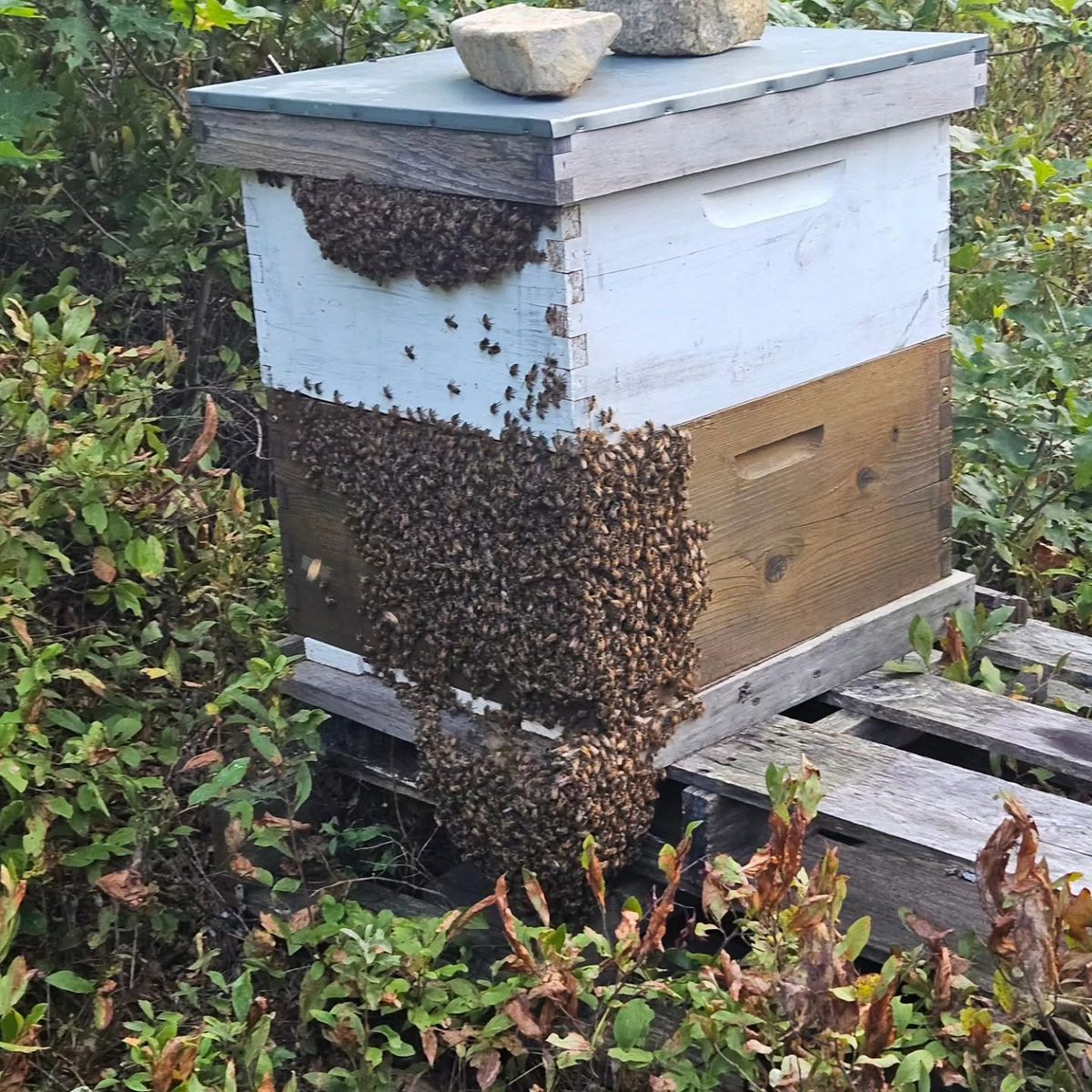
Goats on the back pastureBees working the back acres
Land is how a family’s work outlives them. For twelve years, this ground carried the Bishops’. It’s ready to carry yours.
In the press
In the press
Link copied
Recognized among the farms shaping Rhode Island's agricultural future.
Rhode Island Monthly · Featured among the farms shaping the state's agricultural future.
The neighborhood
Good company
241 Cornell doesn't farm alone. The South Coast is one of New England's living food communities — markets, chefs, and working farms within a few miles of this ground.
Independent farms and businesses, listed as neighbors — not affiliated with this offering.
FAQ
Asked and answered
Do I need farming experience?
Not to buy it. Lenders, especially FSA, will weigh your experience. The resident farmhand stays on, and the owners provide hands-on training before closing and twelve months of advisory support after.
Land, structures, brand, equipment, customers — the package itemizes it.
Can I visit?
By appointment, after the NDA.
Is financing really achievable?
Yes — a residential-style mortgage on the real estate (as little as 5% down for FSA-eligible beginning farmers), plus SBA 7(a) and a seller note for the business portion — see Financing.
Timeline?
Farm and FSA financed closings typically take four to six months from accepted offer.
Listed by
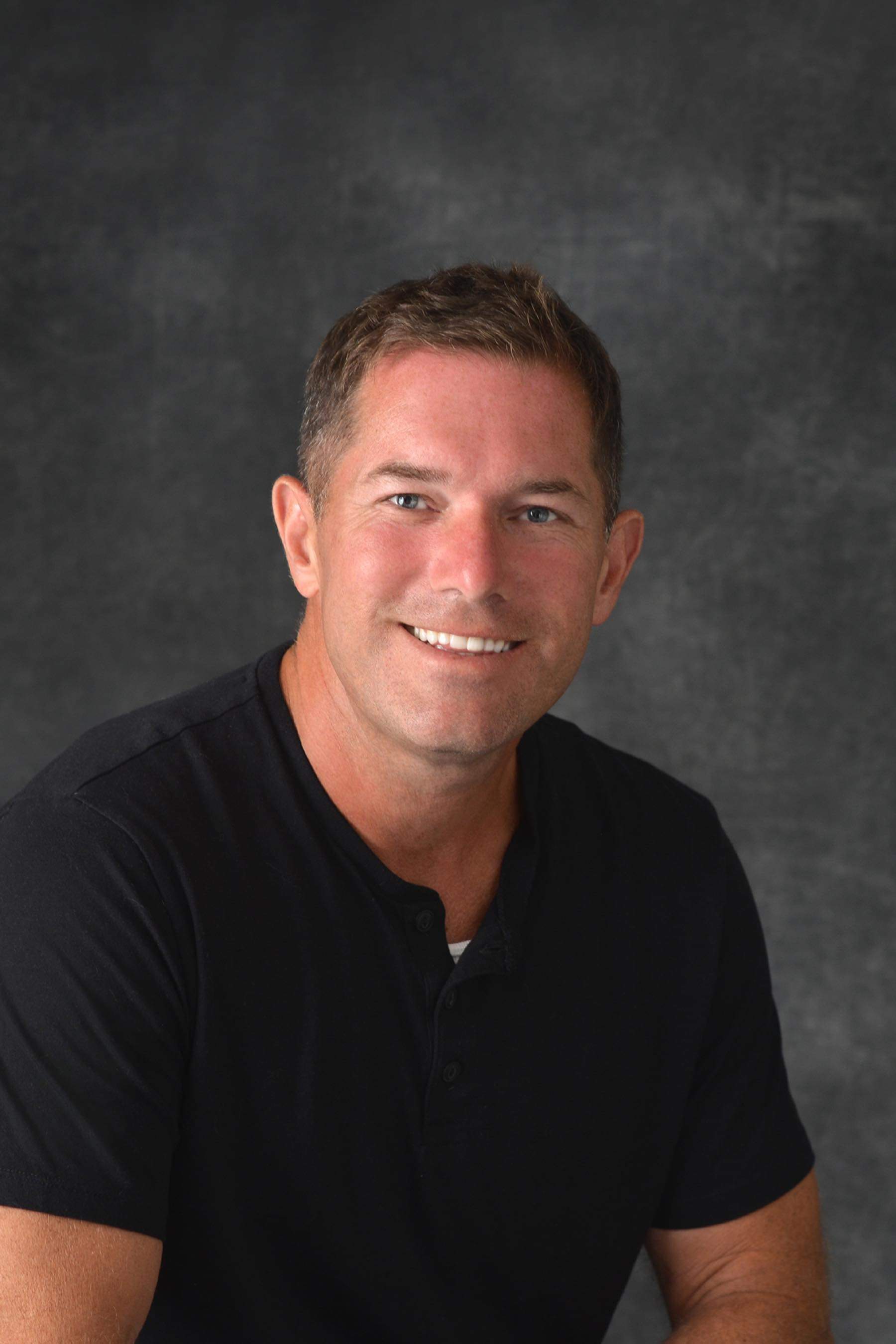
John Long
He prepared and sold Tiverton's marquee water-view estate. Now he's bringing that same preparation to its marquee farm.
The operation runs as-is today. These are levers the next owner can pull — each one independent, none required for the others.
Put the processing unit to work
If the mobile processing unit conveys, with Rhode Island fowl licensure in progress and USDA inspection not yet started.
Then once licensed in the buyer’s own name, process the farm’s own birds, do custom work, or both.
Package Farmhouse Fried Chicken
If the recipe is already the signature draw across the truck and storefront.
Then turn it into a packaged retail product that travels beyond the counter.
Re-cover the 60×200 greenhouse
If a standing quarter-acre steel frame is already on the ground.
Then bring it back to year-round growing under glass.
Deepen wholesale chef accounts
If restaurants already buy and reorder.
Then widen the existing accounts and add new ones on proven product.
Each path is independent — none depends on the others, and the business stands on its own without any of them.
Five-year outlook
Three ways the next five years can run
Indexed to 100 at year one, the same business produces three different curves depending on how hard the levers are pulled — conservative, base, and upside.
UpsideBaseConservative
Illustrative projection
Relative, indexed paths — no dollar figures. Full figures available under NDA.
The full picture
The numbers live in the package
Full financials, revenue detail, and the buyer presentation are available to qualified buyers under a one-page NDA.
Financials, lease detail, and a private walkthrough are available to prospective buyers. Send a note and John Long will follow up — or reach him directly at 774.451.2163 / johnlong@johnlong.realestate.
Inside the buyer package
One signature on a one-page NDA unlocks:
Three Ways to Buy It: the land, the land with equipment, or the whole operation, each with price, what conveys, and how a lender will finance it
FY2025 revenue by channel, the walk from the books to owner earnings, and the open items, stated up front
The itemized equipment schedule
Continuity: the staff who stay, and the owners' training and transition commitment
Available on request as you get serious: both appraisals and the seller's disclosure, plus an introduction to the USDA Farm Service Agency office covering Rhode Island.
If you're buying the business too: federal returns 2023–2025, the general ledger, the market lease, and the grant documentation.
Written so you can hand it straight to your lender.
Not ready to raise your hand? Leave an email — you'll be first to hear when pricing and showings open.
Property records
The public record
Verify everything. The public record is part of the package.
📄
Assessor's Plat Map — Plat 511
The recorded tax map showing Lot 133 and its neighbors.